

Middle school is a confidence crossroads. Your daughter (or student) is learning new academic concepts, navigating shifting friendships, and adjusting to a body and brain that are changing rapidly, all while the social “rules” seem to rewrite themselves weekly.
The data support what many parents and educators believe: girls’ confidence often declines sharply during these years. Surveys and reporting on middle school girls’ self-perception consistently show a noticeable dip during early adolescence.
The good news: confidence isn’t a personality trait someone either “has” or “doesn’t.” It’s a set of skills, experiences, and relationships that can be intentionally built at home and at school.
At Play Like a Girl, we’ve seen for more than two decades what happens when girls get the right mix of support, skill-building, and real-world exposure, especially through sport, mentoring, and hands-on STEM learning.
Below are practical, research-informed ways to build confidence that lasts (not just “hype confidence” that disappears the moment something gets hard).
What Confidence Really Is (And Why It Matters In Middle School)
Confidence is often treated like a vibe: “Just believe in yourself!” But middle school girls don’t need pep talks as much as they need proof.
A more useful definition is:
Confidence = evidence + support + practice.
1. Evidence
“I’ve done hard things before.”
2. Support
“I’m not alone; I have people who see me.”
3. Practice
“I get reps, small chances to try, fail safely, and try again.”
This is exactly why sport and STEM experiences work so well together. Sport builds resilience, teamwork, and strategic thinking; STEM builds problem-solving and “I can figure this out” confidence. Play Like a Girl’s programs intentionally connect those dots.
7 Confidence Builders You Can Do At Home (Without Turning Life Into A “Project”)
1. Praise The Process, Not The Label
Instead of: “You’re so smart.”
- Try: “I noticed you kept going even when it got frustrating.”
- Why it works: labels create pressure (“I must always be smart”), while process praise builds repeatable skills (“I can work through this”).
Quick Swap List
- “You’re talented.” → “That practice paid off.”
- “You’re a natura.l” → “You learned a new strategy.”
2. Give Her “Competence Loops” Every Week
Confidence grows when girls get consistent experiences of:
Try → Struggle → Get support → Improve → Feel capable.
Pick one weekly loop:
- Learning a new recipe
- Building something simple (LEGO, craft, small repair)
- Training for a short run or sport skill
- Teaching someone else a skill she knows
Keep it small. The goal is reps, not perfection.
3. Use “Two Truths And One Stretch” After Hard Days
At dinner, in the car, or before bed:
- Truth #1: “That was hard.”
- Truth #2: “It makes sense you feel ___.”
- Stretch: “What’s one tiny next step for tomorrow?”
This fosters emotional safety and forward momentum, both essential to confidence.
4. Help Her Build A “Brave List,” Not A “Perfect List.”
Have her write 10 things she’s willing to try this month (small counts):
- Ask one question in class
- Try a new club once
- Email a teacher for help
- Attempt a new sport drill
- Share an idea in a group project
Confidence is often just bravery practiced repeatedly.
5. Let Her Struggle (With You Nearby)
One of the fastest confidence killers is rescuing too quickly.
Try the “3-minute pause”:
When she’s stuck, wait three minutes before stepping in. Offer prompts:
- “What have you tried so far?”
- “What’s the next smallest step?”
- “If your friend had this problem, what would you suggest?”
You’re still supportive, just not taking the wheel.
6. Make Body Talk More Neutral At Home
Middle school can turn bodies into “projects” overnight. Keep the home baseline steady:
- Avoid critiquing your own body out loud.
- Focus on function: “Your body helps you do amazing things.”
- Support comfort in clothing and activities (confidence declines quickly when girls feel exposed or judged).
7. Build Leadership Into Normal Life
Give her real responsibility that matters:
- Plan one family meal a week
- Organize a weekend outing
- Lead a game night
- Choose a cause to support and plan one small action
Leadership experiences create “I can” moments that spill into school, friendships, and future goals.
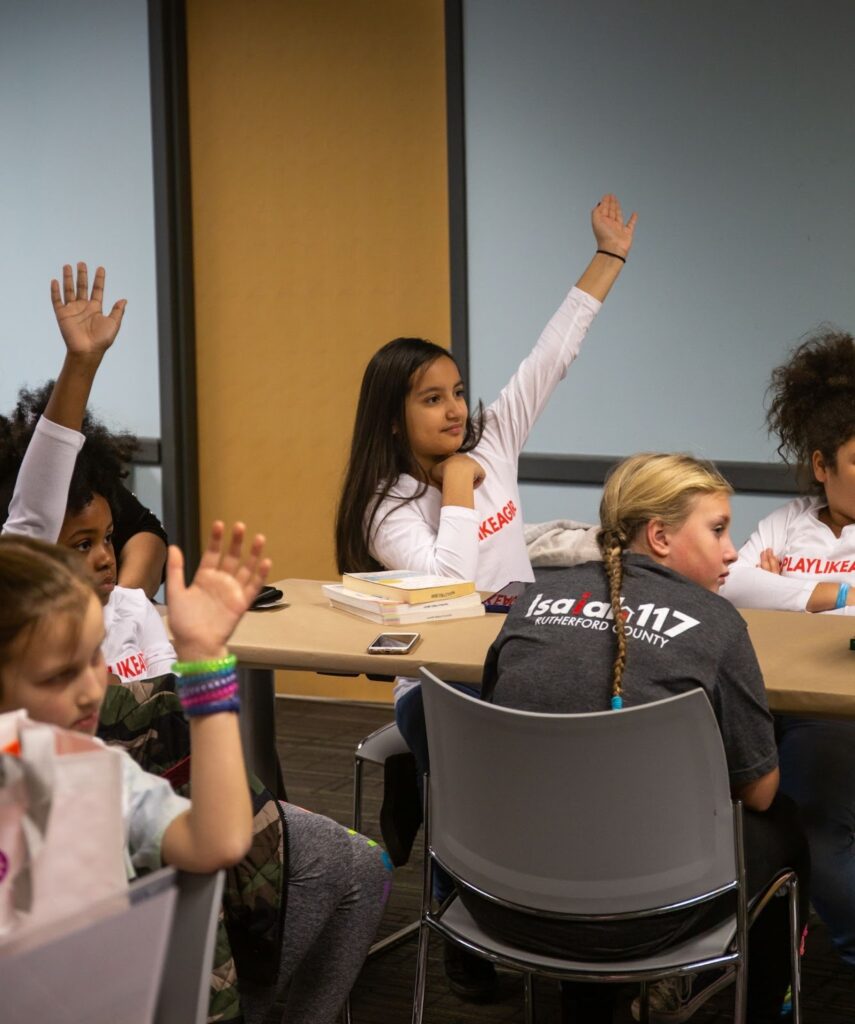
7 Ways Schools Can Build Confidence (That Don’t Require A New Program)
If you’re an educator, counselor, or administrator, these are high-impact moves.
1. Normalize “Learning Out Loud.”
Say things like:
- “Mistakes are data.”
- “Confusion is part of learning.”
- “Let’s test a hypothesis.”
This is especially powerful in STEM classes, where girls may opt out early if they feel behind.
2. Track Participation Patterns Gently
Many teachers don’t realize that the same few students answer most questions.
Simple fix:
- Keep a private tally for a week
- Intentionally invite quieter students in low-pressure ways:
- “Who can add on?”
- “Who has a different approach?”
- “Let’s write first, then share.”
3. Give “Specific Feedback,” Not “Generic Feedback.”
“Good job” feels nice, but it doesn’t build evidence.
Try:
- “Your conclusion matched your data, that’s strong reasoning.”
- “You used a clear example to support your point.”
- “Your revision made your argument easier to follow.”
Specific feedback becomes receipts she can believe.
4. Build belonging before performance
Confidence dies when girls feel like outsiders.
Belonging builders:
- structured group roles (so one student doesn’t do everything)
- rotating leadership roles
- norms for respectful disagreement
5. Offer More Than One Way To Show Learning
Not every confident student is loud.
Include options like:
- Short written reflection
- Visual explanation
- Small-group demo
- Recorded explanation (where appropriate)
6. Make Career Exposure Normal, Not Rare
Middle school girls benefit from seeing real adults in real roles, especially women in fields where girls don’t automatically picture themselves.
That’s why Play Like a Girl’s mentoring and career-connected experiences are built into programming, helping girls connect present skills to future pathways.
7. Use Mentoring To Boost School-Connected Confidence
Mentoring doesn’t fix everything, but research shows it can improve specific aspects of self-belief that matter in school, including adolescents’ perceptions of their academic abilities.
Why Sport Is A “Confidence Training Lab” (Even For Non-Athletes)
Sport gives girls something school doesn’t always provide: visible progress.
- You practice
- You improve
- You learn to handle pressure
- You learn how to be on a team
And participation in sports is often linked to positive academic and well-being outcomes for adolescents.
If your middle schooler doesn’t identify as “sporty,” confidence can still grow through movement:
- Dance
- Martial arts
- Walking club
- Rock climbing
- Intramurals
- Rec leagues that emphasize fun and skill-building
The point is not being the best. The point is learning to stay in the game.
Turn Everyday Moments Into STEM Confidence (No Special Equipment Required)
STEM confidence is really “figure-it-out confidence.” Try weekly micro-challenges:
At Home, STEM Challenges
- Kitchen science: What happens if we change one variable in a recipe?
- Design challenge: Build a phone stand using only paper + tape.
- Data habit: Track sleep or mood for a week and look for patterns.
- Tech curiosity: Ask, “What problem does this app solve and how might it solve it differently?”
The Best STEM Question You Can Teach
When she says, “I’m not good at this,” the coach: “You’re not good at this yet. What’s the next thing we can try?”
That single word yet keeps doors open.
Conversation Scripts That Actually Help (Home + School)
For Parents After A Rough Day
- “That sounds really hard.”
- “I’m glad you told me.”
- “Do you want comfort, advice, or a plan?”
For Teachers, When A Student Shuts Down
- “I see you’re stuck.”
- “That’s part of learning, not a sign you can’t do it.”
- “Let’s find the next smallest step together.”
For Mentors And Role Models
- “Middle school was tough for me, too.”
- “Here’s one skill that helped me.”
- “What’s something you want to feel more confident about this month?”
What To Do If Your Middle School Girl Is “Fine” At Home But Quiet At School
This is common. It usually means:
- She feels safe at home
- She’s spending most of her energy on social risk management at school
Try a two-part approach:
- Build evidence at home (competence loops + brave list)
- Build safety at school (one trusted adult + one structured activity)
A simple first step: help her identify one adult at school she can go to (teacher, counselor, coach), and practice what to say.
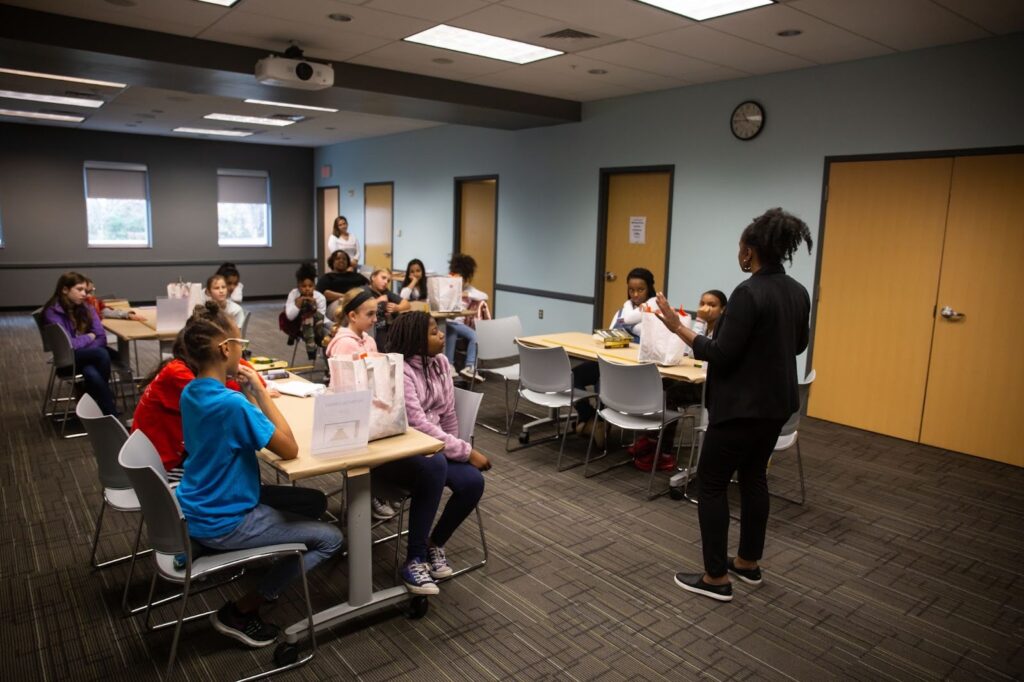
Confidence Grows When Girls Get Reps, Relationships, And Real-World Exposure
If you take one idea from this guide, let it be this:
Confidence isn’t something you “give” a middle school girl. It’s something you help her build one rep at a time.
That’s the heart of Play Like a Girl, using sport, mentoring, and hands-on STEM experiences to help girls grow into who they already are, capable, curious, and ready for what’s next. If you’re a parent, educator, mentor, or partner who wants to be part of that work, explore ways to get involved, mentor, or support programs at iplaylikeagirl.org
Never miss an update!
Stay in the loop by subscribing to our email list.